Beyond Ownership: Rethinking PSE and PSB Reform in India
by Kritika Sharma
5 min read • March 29, 2026
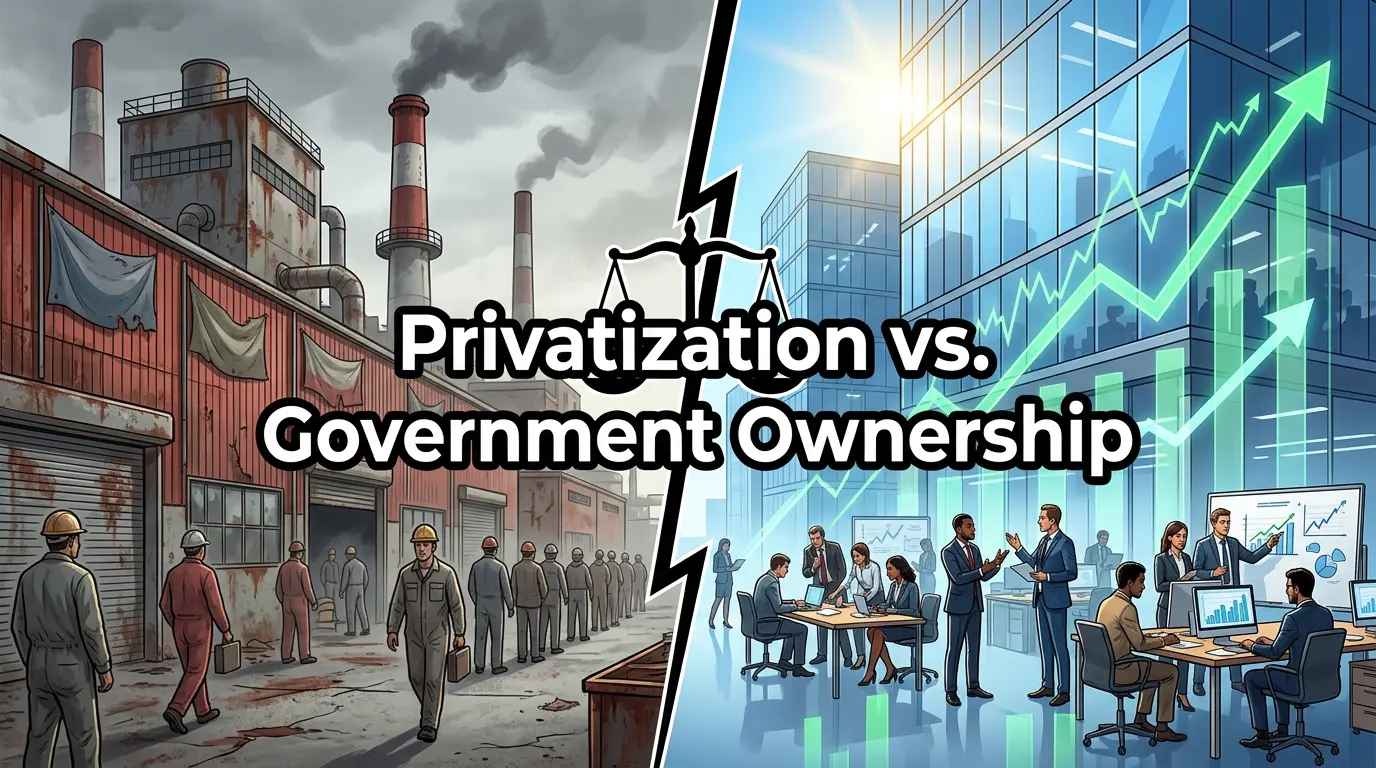
Every year without fail, after the Union Budget is released, the debate around Public Sector Enterprise (PSE) reform emerges. Disinvestment targets are announced and better performance through privatisation is promised. Later, the conversations slacken. Targets are missed, timelines slip and major questions are shelved.
Between FY20 and FY25, the government’s cumulative disinvestment targets stood at over Rs 6.5 lakh crore. However, it collected roughly Rs 1.04 lakh crore. That is less than 16 paise on every rupee targeted. Notably, in FY25, receipts fell to Rs 10,163 crore against a target of Rs 50,000 crore marking the lowest outturn in over a decade. In recent years, the government has significantly reduced its disinvestment targets and poured capital into reviving state-run enterprises. This is not a new phenomenon. The structural problem was identified over two decades ago
In April 2000, former Prime Minister Atal Bihari Vajpayee, called it out plainly. Political parties had used PSEs as "fast breeders of jobs instead of making them sustainable, competitive and fruitful players in the national economy". Twenty-five years later, that diagnosis remains accurate but the implementation hasn’t followed. The real constraint on PSE and PSB’s performance is not who owns these institutions. It is how they are governed.
The Political Interference Mechanism
We often fail to consider the political influences through which performance outcomes are shaped.
Public Sector Banks (PSBs) leadership is effectively government-appointed and hence the most direct channel of political interference. This makes boards accountable to ministries rather than to stakeholders. The Nayak Committee (2014) documented this clearly. The government was simultaneously owner, regulator, and appointing authority, making genuine board independence impossible. It proposed Bank Investment Company as a solution to professionally manage government shareholding, separate ownership from operational control and reduce political interference in board functioning. The committee diagnosed a governance problem and prescribed an ownership solution. The government's own subsequent reform attempt proved the point.
The Banks Board Bureau, set up in 2016 to professionalise PSB appointments, was replaced by the Financial Services Institutions Bureau (FSIB) in 2022, to recommend candidates. The final decision still rests with the Appointments Committee of Cabinet. The structure of political control over PSEs and PSBs leadership still remains intact.
The most profound governance failure stems when public institutions have an implicit guarantee they will be bailed out rather than winded up. The PSB Non-Performing Asset (NPA) crisis is the most documented instance. Between FY17 and FY21, the government injected Rs 3.31 lakh crore into public sector banks through recapitalisation bonds and budgetary allocations while no structural governance change accompanied this infusion. Between FY21 and FY25, PSBs wrote off Rs 5.82 lakh crore in bad loans.
So even though the gross NPA ratio fell from 9.11% in March 2021 to 2.58% by March 2025, a substantial part of this decline reflects accounting removal, not actual recovery. Additionally, BSNL received successive revival packages of over Rs 3 lakh crore since 2019 for capital infusion, debt restructuring, viability gap funding for rural telephony, and spectrum allotment without any governance reform. While the institution has achieved modest profitability the pattern clearly showcases the soft budget constraint.
Does Privatisation Misdiagnose the Problem?
A major assumption with privatisation is that transferring ownership from the state to private hands will by itself, improve performance. Air India puts that assumption to test.
By 31 August 2021, Air India carried a total debt of Rs 61,562 crore. The government sold Air India at Rs 18,000 crore of which the Tatas paid off Rs 2,700 crore in cash, assuming Rs 15,300 crore in debt. Three years after the transfer, Air India and Air India Express posted a combined pre-tax loss of Rs 9,568 crore in FY25.
The privatization of Air India called for an exit, but it did not change the dysfunction that made this exit so necessary in the first place. Ownership change does not automatically bring reform.
PPP as the way forward
Analyzing Public Private Partnerships (PPPs) as a “middle ground” is inherently complex. This is because PPPs are not better nor worse. They work when states can write, monitor and enforce contracts and private companies efficiently deliver on their operational mandate.
India's road sector demonstrates this precisely. The post-2013 cancellations of many BOT highway projects including the GVK's Shivpuri-Dewas highway, a Rs 3,000 crore project did not fail due to the insufficiency of the PPP model per se. It was driven by aggressive private bidding and inadequately prepared projects by the public sector. These cancellations were a result of insufficient land acquisition and delayed environmental clearances on the government's side along with huge bids by the private sector.
On the other hand, South Korea offers a useful contrast. Following the 1997 financial crisis, the government overhauled its PPP framework and established PIMAC - The Public and Private Infrastructure Investment Management Centre at the Korea Development Institute. The institution conducts independent feasibility assessments and value-for-money analyses before any project is approved.
Here, the governance and state capacity was built before the PPP model was used. The contrast highlights something fundamental. Institutional design matters more than the ownership label or bids attached to a project.
Conclusion
Twenty five years since Vajpayee's speech, the issues remain the same. But disinvestment and privatization are not a certain shot to ensure better performance. The constraint on PSE and PSB performance is governance, not ownership. Political interference operates through appointments, soft budget constraints and government bailouts that are not resolved merely by changing ownership. Better governance structures and reform in public institutions are not some radical proposals asked of the government, they are necessary to revitalize the economy. Thus, the real question is not what needs to change, we already know that, it is whether the political will exists to change it.
About the Author
Kritika Sharma is a student of Economics at Indraprastha College for Women, University of Delhi. Her research interests lie at the intersection of public finance, development policy and political economy. She also embroiders, occasionally.