Marks Over Matter: India’s Humanities and Civic Education Gap
by Shubhra Das
6 min read • April 03, 2026
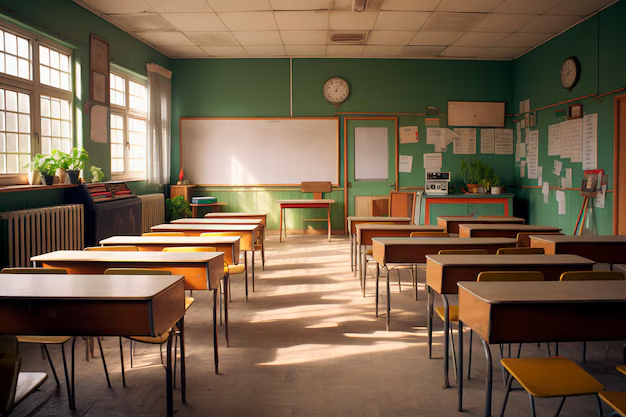
India is often celebrated as one of the world’s youngest nations, home to over 250 million students and the largest schooling system on the planet. Literacy rates have risen from about 18% at Independence to over 77% today. Girls’ enrollment has increased dramatically, poverty-linked dropouts have reduced, and access to education has expanded into rural and marginalized communities. By most quantitative measures, India’s educational growth story seems to be full of it’s own gold stars.
But there remains an uncomfortable question we need to be asking: What are we educating for? Is education merely about producing employable workers, for boosting the economy? Or about cultivating informed citizens capable of thinking, questioning, and participating meaningfully in a democracy?
Since Independence, Indian leaders—from Jawaharlal Nehru to B. R. Ambedkar—imagined education as a nation-building force, not just an economic tool. Yet today, India’s education system centers it’s focus on expansion over depth: more institutions, more degrees, more rankings—but not necessarily better learning.
This structural imbalance is felt most acutely by the current generation, which faces rising youth unemployment (over 23% among urban youth as per recent labor surveys), a widening skill gap, and an education system still dominated by rote memorization. And no part of the system reflects this crisis more clearly than the treatment of the humanities and civic education.
Exam Culture and the Erosion of Thinking
India’s exam-centric model reinforces this imbalance. Success is measured through ranks, cut-offs, and percentages, leaving little room for soft skills such as media literacy, ethical reasoning, linguistic interpretation, or independent analysis. Students learn to memorize rather than evaluate, to reproduce rather than question. It creates a superficial form of learning, an illusion of knowledge through “perfect” answers modelled after textbooks and patterned questions.
India’s obsession with rankings creates a powerful illusion of meritocracy. Marks and positions provide a false sense of accomplishment while often masking a sub-par learning experience. Interdisciplinary education—where science students study ethics and humanities students learn data literacy—would better prepare students for modern challenges. Yet rigid systems of evaluation actively resist this shift, because it threatens the efficiency of the rat race we know of today.
Even reforms like the National Education Policy 2020 acknowledge the need for interdisciplinarity and skill based learning, but implementation remains slow and uneven. And it is due to this system, that subjects based on interpretive thought, rather than analytic thinking, suffer the consequences.
The Quiet Marginalization of the Humanities
In contemporary India, academic streams are arranged in an unspoken hierarchy. STEM sits comfortably at the top, commerce follows, and the humanities—political science, history, sociology, philosophy, literature—are relegated to the bottom. For many students, choosing the humanities is framed not as a preference, but as a fallback.
This perception did not arise accidentally. Over the past decade, India’s institutional focus has leaned heavily toward STEM as a driver of economic growth. Engineering colleges multiplied rapidly, technical degrees were framed as pathways to stability, and national success became closely tied to producing coders, engineers, and managers. While this focus helped build India’s IT and startup ecosystem, it came at a cost: the systematic undervaluing of disciplines that teach critical thinking, ethics, communication, and historical understanding.
The current stream based system, Ironically, disadvantages both “sides”. Humanities students are often denied basic foundational stem courses in their higher studies due to rigid stream divisions, while science students graduate with little exposure to history, politics, or philosophy. The result is a fragmented workforce—technically skilled but civically underprepared.
Historian Ramachandra Guha writes in India After Gandhi, democracies do not survive on economic growth alone—they survive on informed citizens who understand their past and can argue about their future. Yet humanities education, which provides precisely this foundation, is often dismissed as impractical or “non-serious.”
Civic Education: The Missing Core
This disregard extends beyond the humanities into civic education itself. Many students complete twelve years of schooling with limited understanding of Indian constitutional values, world history, media bias, or how political institutions actually function. Concepts like federalism, secularism, free speech, and due process are memorized for exams—if taught at all—rather than critically engaged with.
This absence has serious consequences. When civic education is weak, responsibility shifts unfairly onto individuals to “figure things out” through social media, biased news outlets, or echo chambers. The result is a dangerous coin toss: a 50–50 chance of becoming politically informed or politically manipulated.
In a country where misinformation spreads faster than fact, this gap can—and often does—get exploited.
Why This Moment Matters
The impact is not merely ideological. A narrow educational focus contributes to brain drain and limits workforce diversity, stifles innovation, and weakens leadership pipelines in policy, journalism, education, and public service. According to India Skill Report 2025, only 54.81 percent of the country’s youth will be employable in 2025. This means that four out of every nine Indians of working age do not have skills that match available jobs. These broader challenges of employability are not merely due to a lack of technical expertise, but also because of poor digital fluency, adaptability, and social-emotional competencies.
More critically, it erodes empathy. Without exposure to history, culture, and social analysis, students struggle to understand India’s diversity—of caste, language, religion, region, and ideology. An education system that ignores the humanities cannot reflect the society it claims to serve.
At a time of global political polarization, algorithm-driven media, and democratic backsliding, not just in India, but globally, civic awareness is no longer optional. It is essential. The humanities are not a luxury—they are the backbone of democratic resilience.
As B. R. Ambedkar warned, “Democracy is not merely a form of government. It is primarily a mode of associated living, of conjoint communicated experience.” Without education that teaches students how to think, argue, and empathize, democracy becomes fragile.
So we must ask ourselves: What kind of citizens are we producing?
Conclusion: Reclaiming Education’s Purpose
Respecting the humanities and strengthening civic education is not about choosing ideology—it is about choosing depth over distraction. India’s future depends not only on economic growth, but on citizens who can critically evaluate power, resist misinformation, and understand the complexity of their society.
An education system that reflects India’s intellectual diversity, historical depth, and democratic aspirations is not just desirable—it is necessary. The question is no longer whether reform is needed, but whether we are willing to rethink what we mean by “success” in the first place.
About the Author
I'm a college student, and am currently an editor at Leap For Climate and the Chartium. I love to writing about all things politics, economics and arts and I aspire to research and write about areas related to public policy, demographic shifts, and intersectionality in feminism, especially in the indian context. Also a prolific reader and movie watcher.