Political Devotion and the Crisis of Agency - A Psychotherapist’s Reflection
by Aanandita Pande
10 min read • January 07, 2026
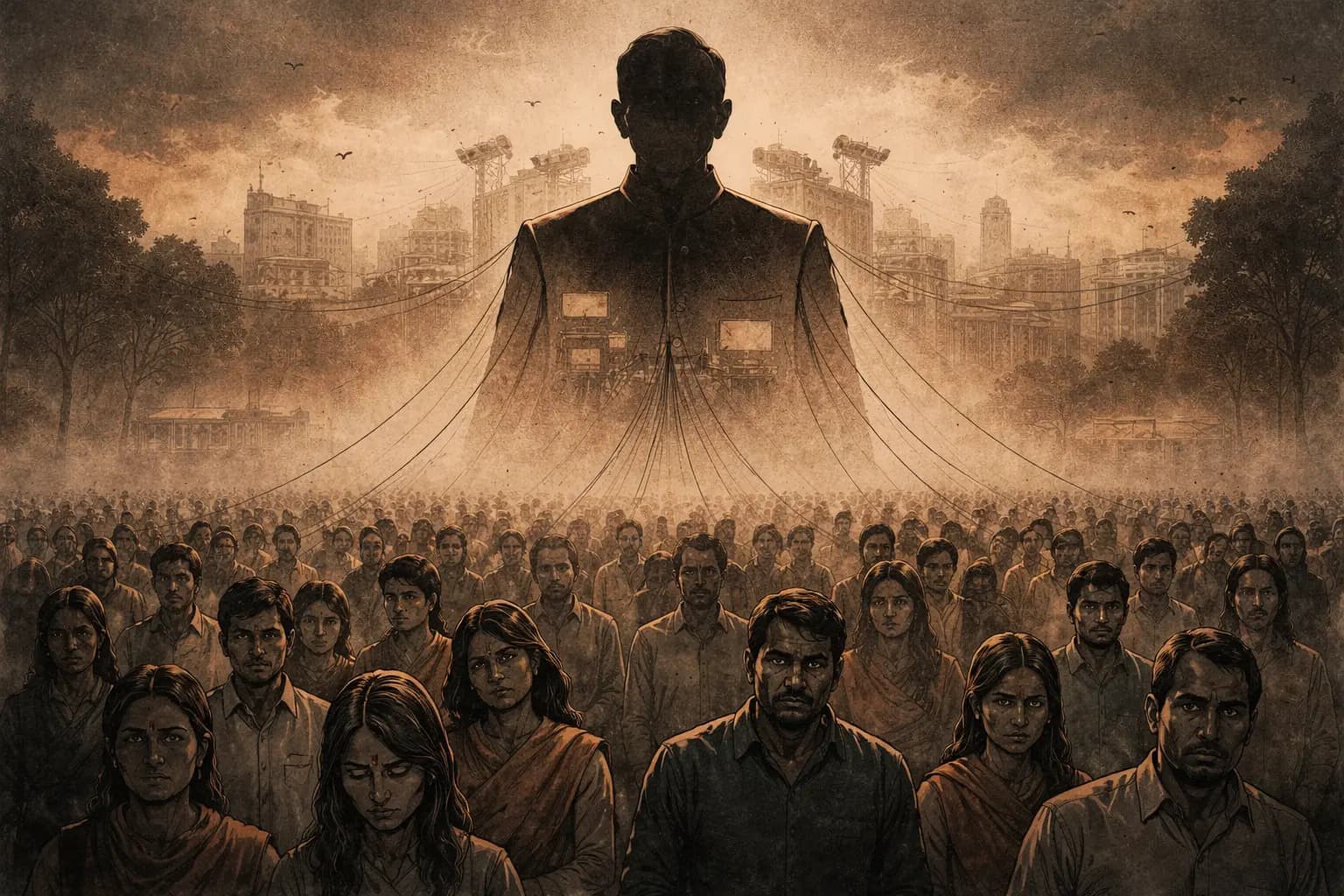
The Psyche of Political Devotion
There are periods in a society when politics begins to feel less like a public process and more like a private relief: when exhaustion sets in so deeply that the promise of certainty starts to sound reasonable, almost necessary. It shows up in how quickly people reach for strong figures when they feel unsteady, how easily the weight of complexity gets traded for the lightness of conviction, and how often disagreements begin to register as a personal threat rather than a political difference – something that destabilizes the self rather than sharpens the argument. What is being offered in these moments isn’t just an opinion or an ideology, but something more intimate: a way out of moral fatigue, a release from the daily strain of having to think, hesitate, reconsider, and remain publicly unsure in a world that increasingly punishes ambiguity.
I want us to stay with the discomfort of this brutal start for a moment.
As a psychotherapist, I am trained to notice what people cling to when their inner world feels uncertain, to track the small adjustments they make to preserve a sense of control when everything else is slipping. At the same time, as a citizen, I live inside the same social currents as everyone else – exposed to the same media cycles, the same debates that narrow with each passing month, and the same everyday conversations that consistently shrink what can be said and how it can be said.
These positions begin to collide when I recognize the relief being circulated around me and feel its pull even as I try to resist it. That is when the appeal of a decisive leader, a singular voice, a national story that promises order and belonging, starts to operate less as politics and more as a psychological shelter, something that steadies the ground beneath people who no longer trust it to hold. In those moments, I am not just an observer of masses using "the nation" to calm themselves; I am also curious about how the same appeal moves through me, how it whispers its small seductions: the promise of certainty, the relief of belonging, the mild but insistent pressure to stop questioning and just let someone else carry the weight.
My training asks me to recognize this as a psychological process. My life as a citizen places me directly inside it.
This is not uncommon in societies weighed down by emotional insecurity, economic precarity, political unrest, or the vertigo that comes with rapid social change: when the ground beneath people feels unreliable, and the future seems both urgent and illegible, the psyche begins to search for something solid, something it doesn't have to question.
The nation, then, becomes more than a political idea. It becomes a psychological shelter.
Political personality cults grow precisely here, never as anomalies but as expressions of the collective ego, as solutions the psyche offers when it can no longer tolerate its own fragmentation.
The Leader as the Collective Ego Ideal
In psychoanalytic terms, the ego ideal is the internal image of who we wish we were, someone stronger, more admired, more certain in their convictions, unburdened by doubt. When a society struggles with uncertainty or finds itself caught in moral confusion, this ego ideal often gets externalized, projected outward onto a figure who seems to embody everything the collective feels it lacks. That is exactly when a political leader is asked to carry it on behalf of millions, to become not just a representative but a stand-in for the self people wish they could be.
This is where the fantasy of omnipotence enters, slyly and seductively.
The psyche loves omnipotence when it feels small, when it is tired of its own limitations and hungry for the relief that comes from believing someone, somewhere, knows exactly what they are doing. A person who is often considered superhuman, even god-like, who has arrived not to govern but to rescue, someone who will restore order, who will give everyone their promised ending, who will make the world legible again. This devotion, when examined closely, is often a disguised wish: Please take this responsibility away from me. Agency is exhausting, and moral ambiguity is painful. An authoritarian leader, in this light, not only offers direction but relief from the burden of choice itself.
Outsourcing Agency
One of the most important functions of authoritarian leaders, and one of the least spoken about, is that they allow people to outsource agency without consciously admitting it or without having to name what they are giving up. When loyalty becomes absolute, and devotion replaces deliberation, the personal responsibility of the individual citizen begins to dissolve, not all at once but gradually, imperceptibly. Ethical conflicts are smoothed over, violence can be justified as a necessity, and silence, once a failure of courage, is reframed as patriotic restraint.
We have seen versions of this across history, each time shaped by its context but animated by the same psychological architecture.
In India, mass mobilization has repeatedly relied on emotional identification rather than critical engagement, on the pull of belonging rather than the friction of debate. From nationalist movements that leaned heavily on moral imagery and mythic narratives, to the Emergency under Indira Gandhi, when the promise of order was sold as national necessity and dissent was recast as disorder, the pattern repeats, each time with slightly different language but the same underlying structure: the leader positions themselves as inseparable from the nation, and so questioning them becomes not just a political act, rather a betrayal, something that places you outside the collective, and outside safety.
Globally, too, this structure is familiar, almost ancestral. Adolf Hitler did not rise only through fear or coercion; he rose through fantasy, through the psychic appeal of a story that promised to repair what had been broken. A wounded nation was offered grandeur, purity, and a restored sense of pride that felt like healing even as it demanded ever-greater sacrifice. More recently, Donald Trump tapped into a similar psychic economy – rage, grievance, and nostalgia fused into a bond that felt deeply personal, almost familial, far more emotional than ideological.
These leaders succeed because they are powerful, but it is not just limited to that. Rather, they become screens for projection, surfaces onto which millions can cast their unmet needs, their unspoken fears, their longing for a world that feels simpler and safer than the one they inhabit.
Narcissistic Identification as a Social Phenomenon
This is often described as narcissistic identification, but it's important to be careful with how that term is heard. What is being named here is not an individual pathology, not a flaw in character or intelligence, but a larger social condition, something that operates at the level of the collective psyche when certain pressures converge.
When people identify with a powerful leader, they are not simply admiring from a distance. They are borrowing strength, certainty, and the fantasy of invulnerability that the leader seems to embody. Just as a child feels protected by the imagined power of a parent, the unconscious logic here is often: If they are strong, then I am strong. If they are certain, then I do not have to live with doubt.
Authoritarian figures arrive with a promise of clarity, with a vision of a world where roles are fixed, enemies are named, hierarchies are restored, and the ambiguity that exhausts people is finally, mercifully resolved.
Propaganda and Emotional Contagion
No personality cult survives without repetition, without the steady rhythm of the same message encountered across screens, conversations, family WhatsApp groups, and public spaces until it stops sounding like a claim and starts feeling like common sense. When something is repeated often enough, it begins to feel true, or at the very least, familiar, and familiarity, in the absence of critical distance, carries its own implicit authority.
Propaganda is not effective because it convinces people through argument or evidence; it is effective because it synchronizes emotion and creates a shared feeling that precedes and ultimately overrides ideology. Once emotional alignment is achieved and people are feeling the same things at the same time in response to the same symbols, the content of belief becomes secondary. What then matters is the bond, the sense of collective movement, the relief of no longer feeling alone in one's uncertainty.
Where Anger Lives
I want to be clear about something: none of this absolves people of responsibility.
Understanding the psychology of political loyalty is not the same as excusing it. There is a point at which surrendering agency becomes a choice, and silence becomes complicity. If you prioritize comfort over ethics, it is still a choice that YOU are making.
And that is where my anger lives. My anger is a refusal to pretend that manipulation only happens to "others." Or that education or intelligence protects us.
Refusing Comfort to Reclaim Agency
If political personality cults reflect the workings of the collective ego, then dismantling them requires more than simply changing leaders or waiting for a different election cycle. It requires something harder and more uncomfortable: a willingness to tolerate uncertainty, to sit with moral tension without rushing to resolve it, to hold questions open even when answers would bring relief. It requires reclaiming agency, not as a grand political gesture but as a daily practice of asking uncomfortable questions: not only who we follow, but why we need to follow so completely, what relief are we buying with our loyalty, and what discomfort are we avoiding by not looking too closely at what is being done in our name?
Nationalism becomes dangerous not when it asks for love of country but when it replaces the self and offers belonging without responsibility, when it asks you to stop thinking in exchange for the comfort of certainty.
And here is what cannot be avoided: as citizens, as thinking subjects, as people who live in language and make choices and carry the consequences of those choices into the world, we are still accountable for what we align with, for what we allow, and for what we refuse to see.
So, the question is simple: what are you not letting yourself see, and who benefits from your blindness? What violence are you willing to ignore as long as it does not name you?
And perhaps most importantly, what are you willing to give up to stop being complicit?
About the Author
Aanandita is a practicing psychotherapist with experience working across individual and community settings. Her work spans gender, sexuality, health, and longevity, guided by a deep interest in how people sustain psychological and physical well-being over time. Alongside her clinical practice, she has led business development, customer success, and C-suite wellness initiatives at leading health-tech startups, integrating human insight with product innovation and scalable impact.