The Big Tech Trap and The Open Source Alternative
by Tanavya Dimri
8 min read • October 22, 2025
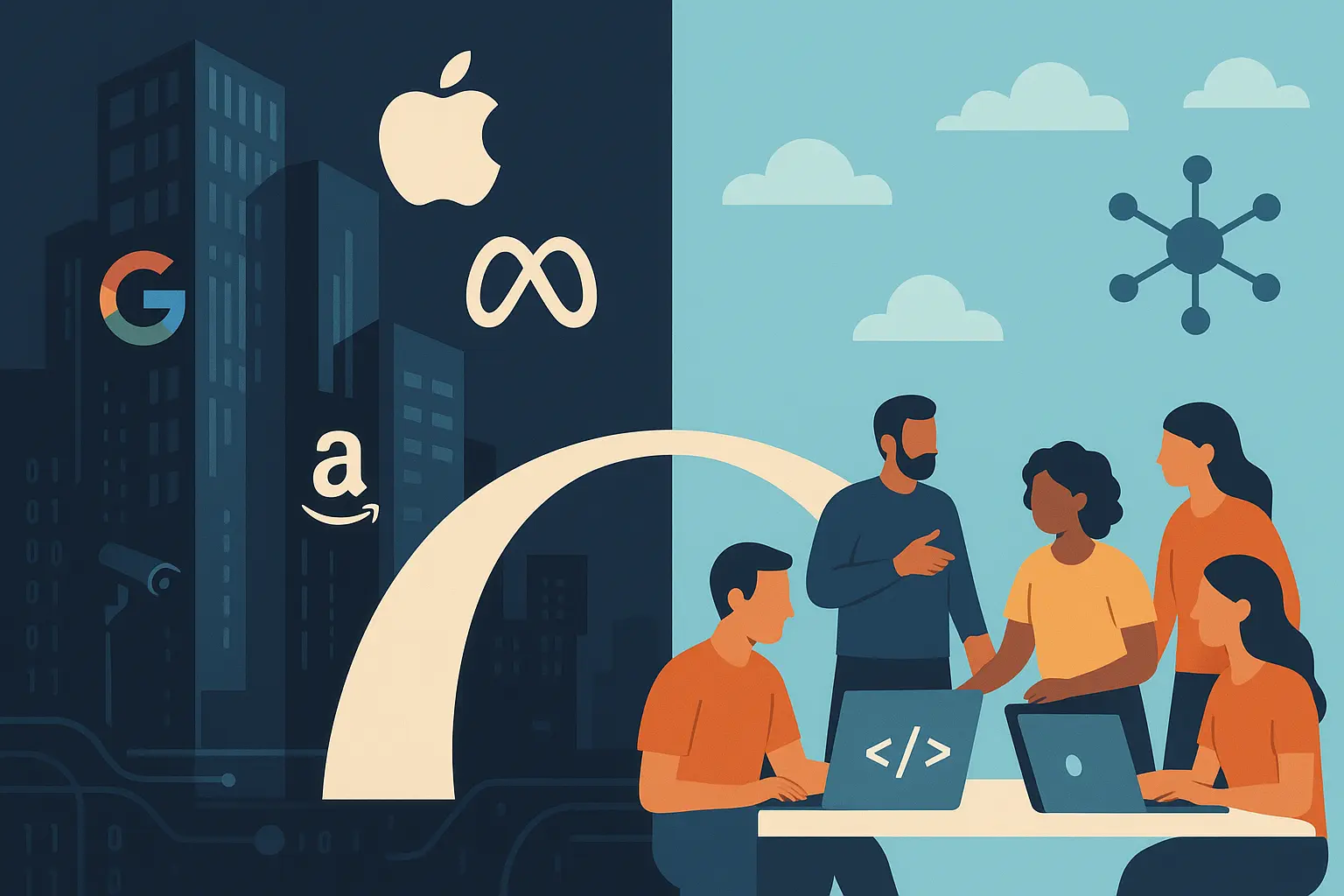
The Big Tech Trap and the Open Source Alternative
We live in a world that is increasingly centered around technology. Industry estimates suggest humanity generates roughly 2.5 quintillion bytes of data every day, a volume so large it is difficult to wrap your head around it. Yet few of us truly know how much of that data we actually own, who governs it, and who profits from it. This concentration of power belongs to the world’s most valuable corporations, with a combined market capitalisation exceeding $10 trillion—the “Big Tech” companies Google, Amazon, Apple, Meta, and Microsoft. The Internet’s core infrastructure is fundamentally decentralised, preventing any single entity from owning it outright. However, Big Tech dominates the design and production of the physical devices, operating systems, cloud platforms, digital marketplaces, and social‑media services that shape the vast majority of our technological experience, especially online.
This concentration of power yields not only invasive data‑monetisation schemes, but also a black‑box development process that hides the inner workings of the software we depend on. Because the code and its decision‑making processes are opaque, governments are able to compel (or covertly co‑opt) these platforms to surveil citizens, censor dissent, and weaponise digital infrastructure against political opponents.
Is there a better way to develop, share, and use the technology that permeates our lives? Yes—open‑source software is the only genuine alternative. By publishing the code, roadmap, and governance for all to see, it empowers developers, users, and the broader society to create tools for the common good, instead of serving a handful of private shareholders whose sole aim is to churn our personal data into profit and a ruling class that wields that very data to silence dissent and consolidate power.
The Silent Threat
Big Tech’s breakthroughs have given us instant access to communication, commerce, and entertainment, but that convenience comes with a hidden price tag: our data privacy, our rights as consumers, and our ability to speak freely online. Below are some of the most salient cases that illustrate each of these three concerns.
- Data‑privacy erosion: You pay not with your money, but your data. The 2018 Cambridge Analytica scandal revealed how Facebook (now Meta) let a third‑party app harvest the profiles of up to 87 million users and then sold those detailed psychographic dossiers to political advertisers eager to micro‑target voters. A few years later internal investigations revealed that Meta’s mobile apps systematically collected users’ precise GPS coordinates, even when the apps had no functional need for location data, and fed those timestamps into its advertising platform to sell “hyper‑local” ad placements at premium rates. In both cases the core business model was the same: extract raw user data, enrich it with behavioural signals, and package the result for the highest‑paying advertisers, turning every click, swipe, and footstep into a monetisable asset.
- Consumer-rights violations: These violations emerge whenever corporations decide to rewrite the rules of ownership and access, usually to tighten their control over the market. Few industries make this clearer than smartphones. Many manufacturers design their devices to age out of usability just a few years after release, through discontinued updates, sealed hardware, and repair restrictions, pushing consumers to upgrade whether they want to or not. This deliberate shortening of product lifecycles mirrors a similar shift in the video-gaming world, where the 2024 “Stop Killing Games” movement has quietly pushed back against publishers that make games vanish when they end support. In both cases, products are sold as if they belong to us, but their lifespan is dictated entirely by the companies behind them. These tactics reveal how planned obsolescence has become a tool of control and how consumer pushback can start to challenge it.
- Digital‑speech suppression & surveillance: Perhaps the most insidious violation of civil liberties, as it attacks the very ability to participate in public discourse and threatens society’s most vulnerable communities. Public awareness of the extensive surveillance state grew significantly following the 2010 global surveillance disclosures from documents leaked by former NSA contractor Edward Snowden. More recently, the 2020 Amazon Ring doorbell scandal highlighted how we are still hurtling towards a dangerous future, when it was revealed that users had unwillingly agreed to share live video feeds with hundreds of U.S. police departments, granting officers access without explicit consent. This footage could then be shared with other law enforcement agencies and private contractors, effectively transforming ordinary households into nodes of a sprawling surveillance network.
An Optimistic Future
The open‑source movement traces its philosophical roots to Eric S. Raymond’s 1997 essay, “The Cathedral and the Bazaar”. Raymond contrasted the tightly‑controlled, “cathedral” style of traditional software development, where a small, isolated team builds a product behind closed doors—with the chaotic yet collaborative “bazaar” model in which anyone can contribute, critique, and iterate. His thesis that software should be built openly became the cornerstone of today’s open‑source ecosystem.
Imagine a world where we collectively decide which features matter, pool resources across borders, and build the tools we need instead of waiting for proprietary vendors to prioritize profit over public good. India, for instance, already boasts around 5.67 million IT professionals as of 2025, many of whom are under‑paid relative to global market rates and caught in a cycle of outsourcing for foreign firms or low‑margin contracts for domestic tech giants. This talent surplus coexists with rising graduate unemployment, even as the demand for new, socially‑impactful software continues to explode. The paradox dissolves when we recognise that a lot of software can be built and maintained openly, with contributors sharing ideas, fixing bugs, and adding features as co‑developers rather than passive consumers.
Below are some areas and popular projects that anyone can start using, contributing to, and championing open‑source alternatives:
- Browsers and LLMs: Google Chrome dominates the browser market and has faced antitrust fines, such as the EU’s €1.49 billion penalty in 2024. Open‑source browsers such as Brave, DuckDuckGo and LibreWolf give users control over tracking, advertising, and data collection. Moreover, they even have built-in LLMs (such as duck.ai) with a user experience rivaling the likes of ChatGPT, which have been securely hosted and vow protection against conversations being tracked.
- Secure Messaging: Signal is the de‑facto open‑source standard for end‑to‑end encryption. Its cryptographic protocols are publicly auditable, meaning the encryption keys, like the locks on your front door, never leave the device. In contrast, WhatsApp and iMessage retain the encryption key material and metadata on their servers, and states such as India and the United States, have repeatedly compelled these services to surrender that data, including the contents of private messages, despite frequent claims that state actors do not have access.
- E-Mails, Password Manager and Storage Drive: There are a myriad of open‑source projects that build solutions for such every-day usecases, often with paid platforms for premium features. Among them, the Swiss tech company, Proton, stands out. Founded by former CERN researchers and advised by luminaries such as the founder of the World Wide Web, they have grown into a successful company with hundreds of employees and over 100 million users. Although much of their codebase was restricted initially, likely for security reasons—Proton has progressively open‑sourced all client‑side applications (the code that runs exclusively on your device), while retaining a proprietary server‑side infrastructure that ensures the platform is secure, scalable and financially sustainable. With more than ten integrated services based on Proton Mail, they offer a convenient alternative to the monopolistic cloud offerings from Apple and Google, freeing users from the lock‑in and discomfort of having all their data tied to a single provider.
- Collaborative Editing: CryptPad offers a complete suite for documents, spreadsheets and presentations. Because all encryption and rendering happen in the browser, no plaintext ever touches CryptPad’s servers, delivering strong guarantees against data leakage.
Websites such as alternativeto.net catalog thousands of open‑source projects that serve as viable alternatives to mainstream software—from Discourse, an open‑source replacement for Discord/Slack, to community‑run voting and financing platforms like Open Collective, and many everyday tools like the popular VLC Media Player or the note taking app Joplin. These projects thrive on community involvement; whether you’re a designer, a software engineer, or simply an everyday user who raises bug tickets and requests features—everyone’s contributions matter. The technological revolution we need starts now. By adopting open‑source tools, spreading awareness, and contributing code and documentation, we can forge a future defined by transparency, collaboration, and openness to new ideas. When users become co‑developers, the power to shape the future of technology shifts from a handful of corporations back into the hands of citizens.
About the Author
Tanavya Dimri earned a Computer Science degree from the University of Waterloo in Canada. He currently works as a Senior Software Engineer at JuumeAI, is a founding member of the fintech startup WealthyPlanet, and previously interned at Nokia and the e‑commerce platform Faire. He envisions a future where open‑source technology completely replaces the big-tech corporations that control the digital world. Recently, he has started actively swapping out proprietary services for solutions that are either self‑hosted or provided by open-source based vendors, while guiding and empowering others to build and sustain their own, independent, open‑source‑powered communities.